
The proven alternative
Hot foam weed control. Proven, chemical-free, and ready to work.
The science is simple. The results are consistent. Here's why hot foam has become the global standard for herbicide-free grounds management.
Independently tested. Academically validated.
The research behind hot foam is public, peer-reviewed and independent of us.
Hot foam has been tested in academic trials and used in some of the most demanding green spaces in the world. Studies from the University of Pisa and the Agricultural University of Athens found it highly effective, with results comparable to glyphosate in controlled testing. Independent field trials comparing flame, steam, hot air and hot water found hot water needed the fewest treatments per season of the thermal methods, three against 5.5 for steam and hot air (Rask et al., 2013). Hot foam extends that same mechanism further, holding lethal temperature roughly nine times longer than hot water alone (University of Pisa, 2021). Nothing leaches into soil, water or air, and nothing is left behind for people, pets or wildlife.
Foam holds the heat where hot water loses it
Peer-reviewed trials show that adding foam to hot water lowers the water dose needed by at least 2.5-fold, because the foam keeps lethal temperature on the leaf and crown for longer than hot water alone (Martelloni et al., 2021).
Matched glyphosate, without a single chemical
In independent trials, hot foam has matched glyphosate's results, including on some of the most stubborn invasive weeds, with nothing going into the ground.
Nothing left behind
Nothing leaches into the soil, the water or the air, and no residue is left for people, pets or wildlife, just clean ground and a weed population that shrinks season on season.
"Hot foam reduced weed biomass by up to 81%, 88%, 90% and 96% compared to mulching, mowing, pelargonic acid and the untreated control."
"Hot foam and glyphosate resulted in the lowest NDVI and weed biomass."
"Adding foam to hot water made it possible to lower the required dose of water by at least 2.5-fold compared to hot water used alone."
"Hot foam applications represent a new, smart concept in the area of thermal weed control."
Peer-reviewed
Studied by the Agricultural University of Athens, the University of Pisa and others, published in the peer-reviewed literature since 2016.
Benchmarked against glyphosate
Directly compared with glyphosate, hot water, mowing, mulching and pelargonic acid, matching or beating the alternatives on biomass reduction and regrowth.
Proven in the field
Trialled in vineyards, olive groves, public parks and Swedish municipal spaces, the settings that matter for councils, estates and contractors.
Hot foam is a mature method of thermal weed control, studied in the field since 2016 and in commercial use across more than 40 countries.
Key references: Antonopoulos et al. (2023), Martelloni et al. (2019, 2021), Cederlund & Börjesson (2016). Full citations available on request.
The direction of travel is already set
Herbicide restrictions are already written into contracts.
More than 80 UK local authorities have introduced restrictions or moratoria on glyphosate use on public land, and the number rises each year. Across Europe, national bans on non-professional and municipal use have been in force for years, France prohibited chemical weed control on public green spaces from 2017, and others have followed.
Herbicide-free clauses are now standard in an increasing share of grounds maintenance tenders. The organisations that move first hold the advantage.
How it works
A hot, insulating blanket that reaches the crown of the plant.
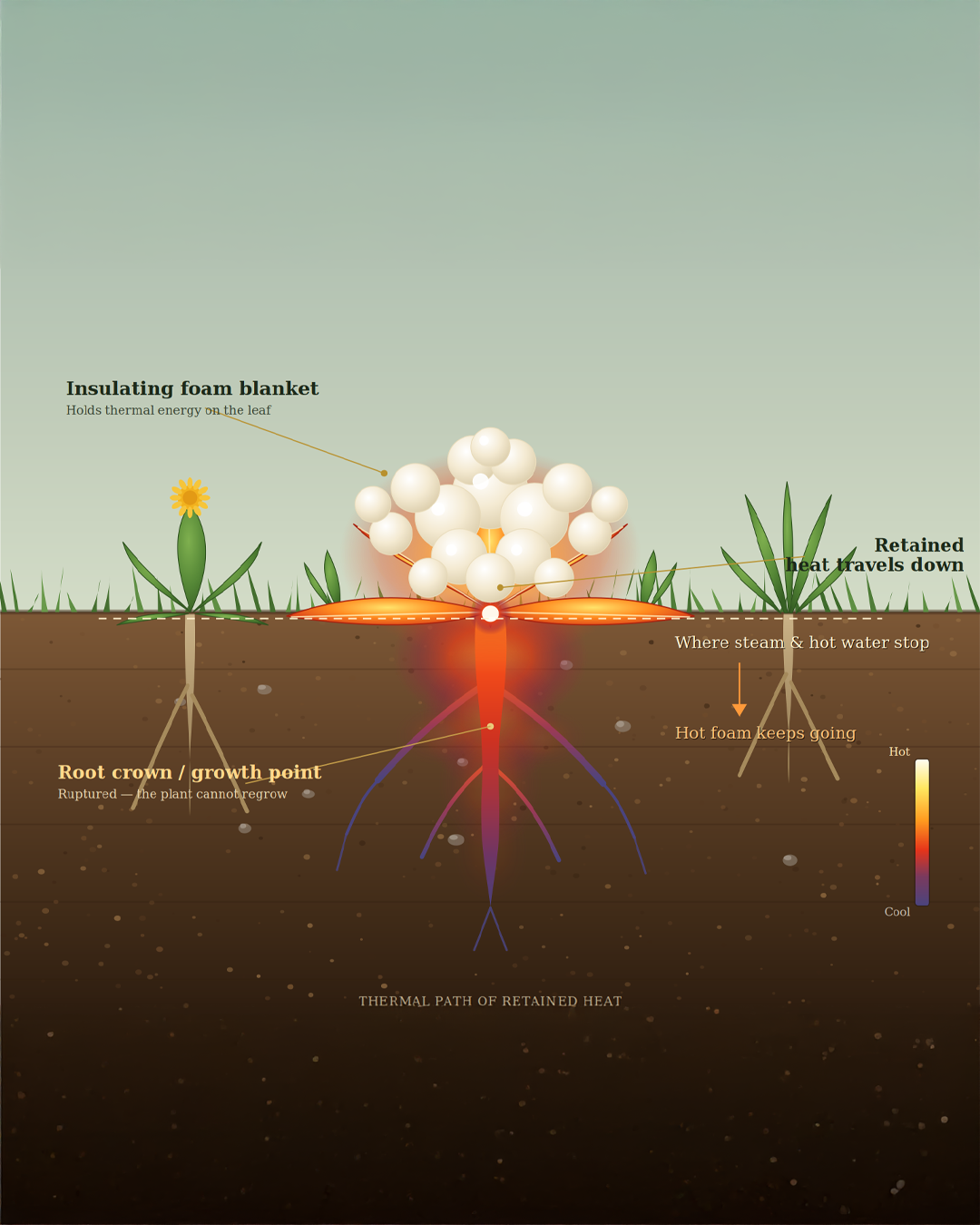
Water is heated on board and combined with our foam, which is made entirely from plant sugars and plant oils, corn and potato starch and coconut oil. When applied, the foam clings to the leaf and holds thermal energy in place long enough to rupture cell walls and destroy the growing point, including the root crown that hot water and steam alone can miss.
It is organically approved and completely biodegradable. The foam breaks down within minutes, leaves no residue and enters the soil as nothing more than water. There is no chemical, no drift, no waiting period.
What's in the foam
- Made from plant sugars and plant oils
- Corn and potato starch, and coconut oil
- Organically approved
- Completely biodegradable, breaks down into water
Hot foam vs hot water
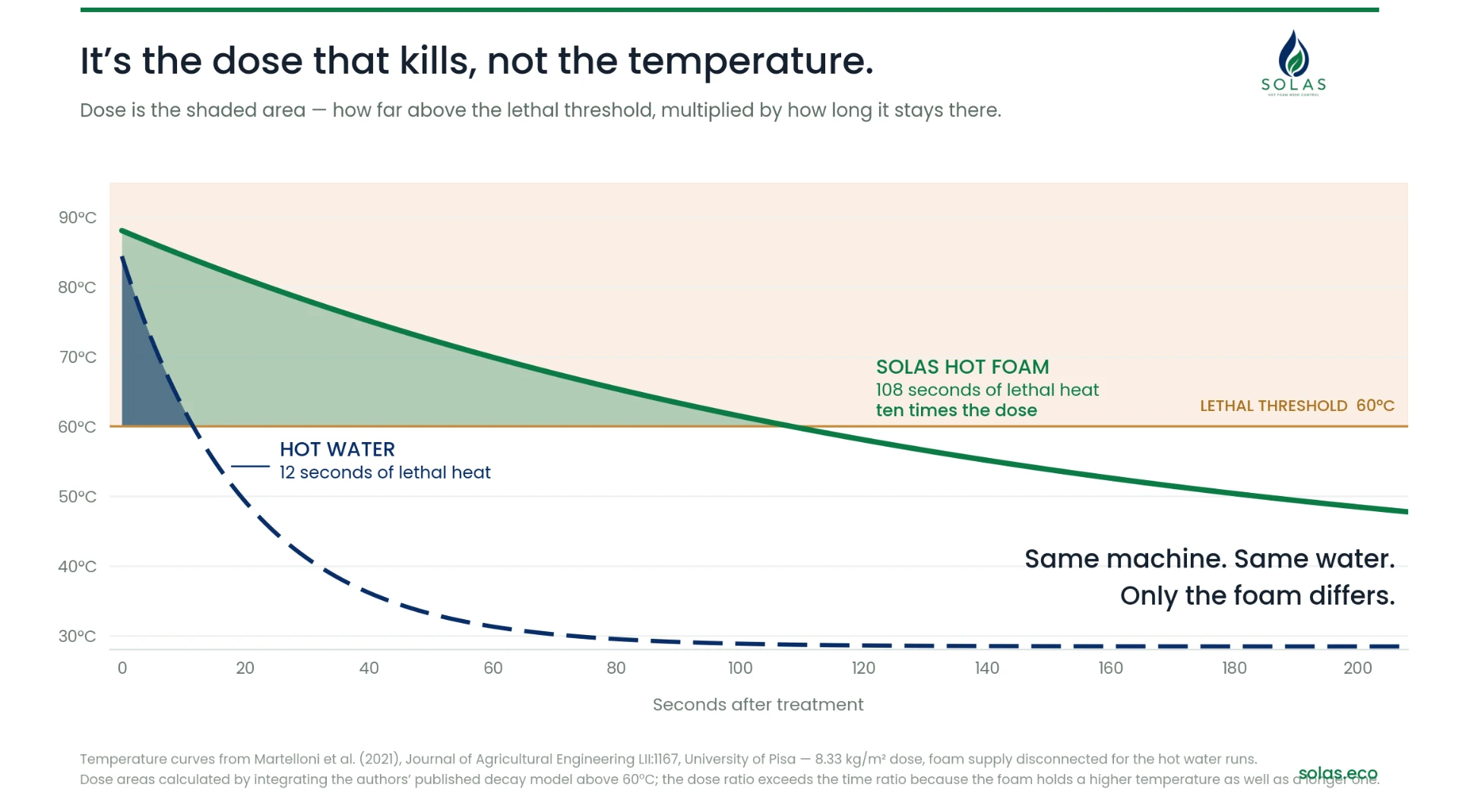
Hot foam vs hot water weed control: 108 seconds against 12.
Both methods are hot water and both are herbicide-free. The foam kills nothing on its own, it simply stops the heat escaping before it has done its job. Think of a cup of tea. In a mug it is lukewarm within minutes. In the flask in your van it is still hot at three in the afternoon. Same tea, same starting temperature, the only difference is whether anything is holding the heat in. Hot water on a weed is the mug. The foam is the flask.
That isn't our claim to make, and it hasn't been measured once. It has been measured twice, by two research groups with no connection to each other or to us.
University of Pisa, 2021
Researchers ran hot foam and hot water on the same machine, with the same water, across seven dose levels at two field sites, disconnecting the foam supply for the water runs. Thermocouples logged temperature at ground level.
| Held above | Hot water | Hot foam |
|---|---|---|
| 70°C | 6 seconds | 60 seconds |
| 60°C | 12 seconds | 108 seconds |
| 50°C | 19 seconds | 184 seconds |
To reach the same 99% control, hot water needed 2.5 to 2.7 times the dose: proportionally more water, more fuel and more time on site. Below 5 kg/m², plain hot water never reached a 70°C peak at all.
BOKU Vienna and the Bavarian road maintenance service, 2024
A separate team, on different equipment, took a penetration probe to a foam application in 21.4°C air.
| Time after application | Under the foam |
|---|---|
| On application | 90.8°C |
| 1 minute | 83.7°C |
| 3 minutes | 67.8°C |
| 5 minutes | 48.6°C |
A drop of under 8% in the first minute. Different country, different machine, different research question, and the same decay curve.
Straight answers
What the evidence supports, and what it doesn't.
We'd rather you trusted our numbers than were impressed by them.
Foam kills seed lying exposed on the surface. It does not sterilise a seedbed.
The 2024 BOKU study is, as far as we know, the only work that has applied hot foam directly to seeds and measured survival. Over a five-minute application, far longer than a working pass, foam was effective only on seeds lying unprotected on the soil surface. Dry seed covered by vegetation, leaf litter or a centimetre of soil survived: for common ragweed, 88% of it. We used to describe this as sterilising the seedbed. It isn't, and we've corrected it.
Regrowth: the honest finding
At matched doses, the Pisa study found no significant difference in regrowth between foam and water beyond 11 to 16 days, and no difference in dry biomass at 30 days. What it establishes is dose efficiency, the same kill from 2.5 times less water, not a longer-lasting kill at equal dose. Deeper damage and slower regrowth are driven by dose, which is exactly what the foam makes affordable.
No thermal method clears a site in one visit
Anyone who tells you otherwise should be asked to produce the trial.
The compounding effect
So why does the weed population fall year on year?
Not seed sterilisation. Four mechanisms, all documented, and they compound.
You stop the seedbank being refilled
Seedbanks are topped up mainly by newly shed seed, and they decay on their own: six to seven half-lives to lose 99%. Prevent seed return and that decay does the work for you. Where plants have been cleared before seed set for two seasons running, seedbank and population densities have fallen by more than 99%.
You don't disturb the soil
Germination is cued by disturbance, light and swings in temperature. Mechanical methods keep lifting buried seed back into the germination zone, which is why strimming and brushing hold or increase weed populations over time. Foam leaves the surface intact, and seed left on the surface is more exposed to predation.
You exhaust perennial root reserves
Every time new growth is destroyed, the rootstock spends stored carbohydrate rebuilding it. Repeat before it recharges and it starves. A better thermal dose means deeper damage and slower recovery, so fewer chances to recharge.
Some surface seed does die
A contributor at the margin, not the engine.
Which is why timing matters more than anything else in the programme. Treat before plants set seed and you're emptying the bank. Treat after and you're tidying up. That's the difference between a schedule and a series of visits.
Key references
- Martelloni, Frasconi, Sportelli, Fontanelli, Raffaelli & Peruzzi (2021), 'Hot foam and hot water for weed control: a comparison', Journal of Agricultural Engineering LII:1167, University of Pisa
- Hall, Urban, Durec, Renner-Martin, Kaul, Wagentristl & Karrer (2024), 'Heat Treatment of Seeds to Control Invasive Common Ragweed, Narrow-Leaved Ragwort and Giant Hogweed', Plants 13(3):341
- Martelloni et al. (2019), 'The Use of Different Hot Foam Doses for Weed Control', Agronomy 9:490
- Antonopoulos et al. (2023), 'Hot foam: evaluation of a new, non-chemical weed control option in perennial crops', Smart Agricultural Technology 3:100063
- Dahlquist, Prather & Stapleton (2007), 'Time and temperature requirements for weed seed thermal death', Weed Science 55:619-625
- Rask, Larsen, Andreasen & Kristoffersen (2013), Weed Research 53:249-258
- Cederlund & Börjesson (2016)