
I've had this conversation in car parks, at trade stands, on the phone to grounds managers who'd already made their minds up, and on more than one conference panel where we were all meant to be being polite about each other. Hot foam or hot water. It comes up every single time.
And I've come to think our side of the industry has been arguing it badly. Including me. The foam companies talk about foam. We put it in the product name, we put it in the brochure, we hand over a price per litre and then act surprised when a procurement officer compares that price against water, which is free. That's not a fight you win. You've handed them a cost and asked them to trust you about a benefit.
So let me try to do it properly, and concede a few things on the way.
First, the thing foam companies should say more often
The foam doesn't kill anything. Heat kills weeds. The foam has no herbicidal properties whatsoever, it isn't a chemical, and if you sprayed it on a dandelion cold, the dandelion would be entirely fine. Anyone selling you foam as the active ingredient is selling you something that doesn't exist.
Both methods are hot water. Both are herbicide-free. Both are safe around children, pets and pollinators. Both need no licence and no PPE beyond gloves. Both go on at low pressure, so there's no blast, no debris and no damage to pointing. Both work in soft landscaping too, which people forget: nothing drifts and nothing stays in the soil, so you can treat right up to the edge of a bed and replant the same day. Worth saying that anything you actually touch will die, because it doesn't know a weed from a bedding plant, so a steady hand around planting is still part of the job.
If you're choosing between hot foam and hot water, you've already made the important decision. Everything after this is about efficiency.
The bit that nobody explains properly
Water at 98°C is only a weedkiller while it's still hot. The moment it lands on a leaf it stops being a body of water. It's a film a fraction of a millimetre thick, sitting in open air. It doesn't cool gently. It's gone in seconds.
Think about a cup of tea.
Pour it into a mug and it's lukewarm before you've finished reading anything. Pour the same tea into the flask in your van and it's still hot at three in the afternoon. Same tea, same starting temperature. Nothing whatsoever was done to the tea. The only thing that changed is whether anything was holding the heat in.
Hot water on a weed is the mug. The foam is the flask.
That's genuinely the whole thing. The foam isn't clever: it's a layer of tiny bubbles going down in the same pass, and trapped air is a very poor conductor of heat. It stops the warmth escaping before it's done its job.
Which is why operators watching steam come off a treated weed reasonably assume the plant is cooking. What they're actually watching is the heat leaving.
What happens when someone measures it
In 2021 a team at the University of Pisa did the experiment properly. Same machine, same water, same doses. For the hot water runs they simply disconnected the foam supply. Thermocouples on the ground, logging every second.
| Held above | Hot water | Hot foam |
|---|---|---|
| 70°C | 6 seconds | 60 seconds |
| 60°C | 12 seconds | 108 seconds |
| 50°C | 19 seconds | 184 seconds |
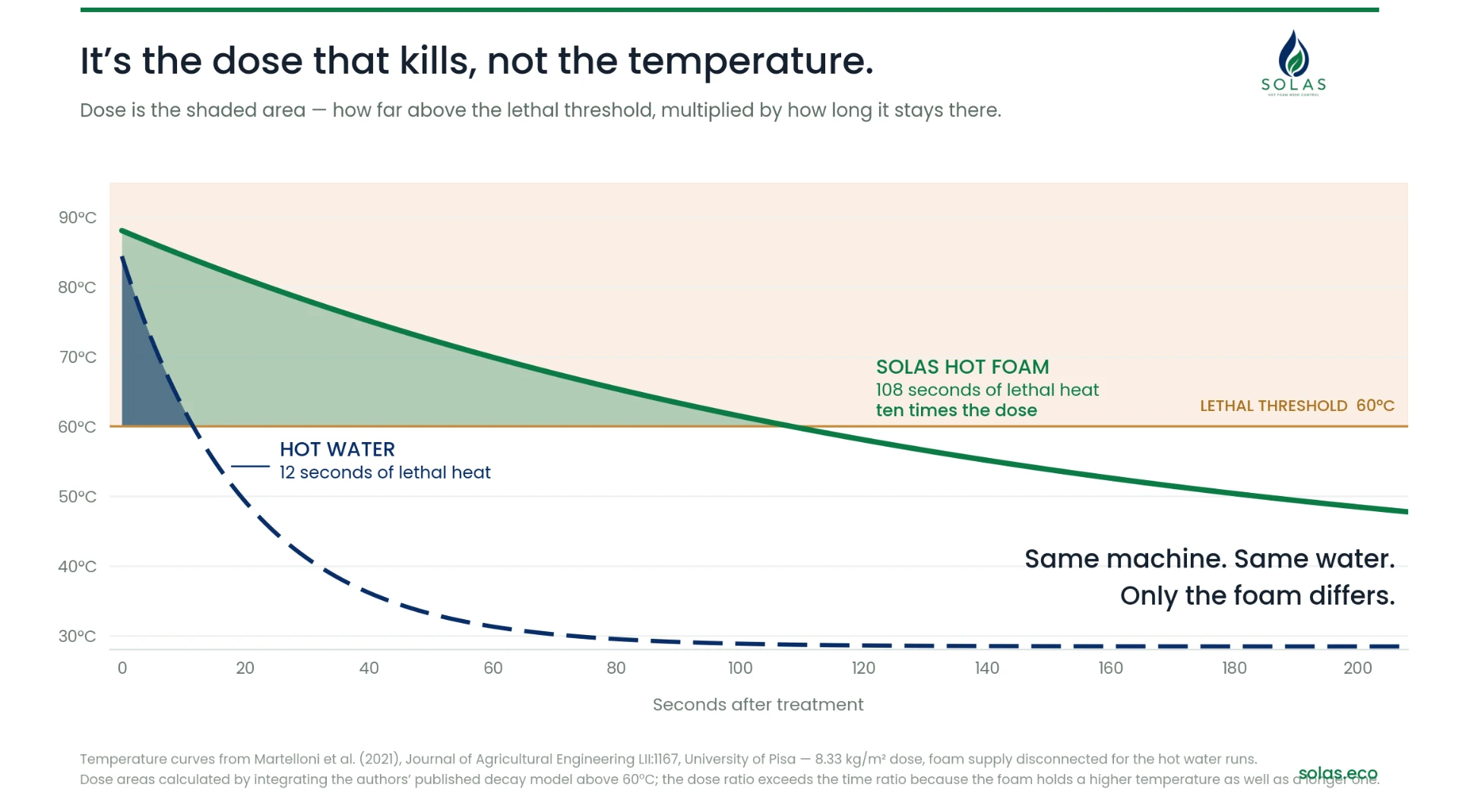
Twelve seconds against a hundred and eight. Weeds don't die at a temperature, they die from a dose: temperature multiplied by time. So the question isn't how hot your machine gets, it's how long the plant stays above the line, and that's the number nobody in this industry puts on a spec sheet.
The commercial bit falls straight out of it. To get the same 99% control, the hot water runs needed two and a half times the dose: two and a half times the water, two and a half times the diesel to heat it, two and a half passes where one would do.
There's one more detail in that data I find genuinely alarming. At doses below 5 kg/m², plain hot water never reached a 70°C peak at all. Its peaks came in at 58, 61, 60 and 69 degrees. At the speeds people actually work at, it may not be getting into the lethal band in the first place.
And then somebody else measured it, separately
In 2024 a team at BOKU Vienna, working with the Bavarian road maintenance service, was researching something else entirely: whether heat treatment could kill invasive weed seeds. Different country, different machine, different question. They put a probe under a foam application in 21°C air and recorded it.
90.8°C on application. 83.7°C after a full minute. 67.8°C at three minutes. 48.6°C at five. A drop of under 8% in the first minute. Two research groups who've never spoken to each other, measuring the same effect and getting the same curve.
Straight answers to the four objections
The hot water companies make a decent case, and one of their arguments is a lot better than the others. Let me take them in order.
“The foam is just a visual indicator so you can see where you've been”
I understand why people think this, because on some machines it more or less is. Foam quality varies enormously and a thin, fast-collapsing foam does very little.
But the effect itself has been measured, twice, by two universities with no commercial interest, using a probe and a thermocouple. It isn't a marketing claim. The number is 108 seconds against 12.
“The real damage happens in the soil, so a few extra seconds above ground is irrelevant”
This is the good one, and it deserves a proper answer rather than a brush-off. The argument runs that soil is a better insulator than foam, that hot water keeps root-zone temperature above lethal for twenty or thirty minutes, and that surface contact time is therefore a rounding error.
Two problems with it. If soil heating were doing the work, then putting less water into the soil ought to give you a worse kill. Pisa found the opposite: hot foam achieved the same control with two and a half times less water going into the ground.
And we can check the soil claim directly. The 2024 Vienna study buried seeds a centimetre down and treated them. If the soil really sat above 60°C for twenty minutes those seeds would be cooked, because published work puts seed death at roughly ten to forty minutes at 70°C. Instead, 75% of the buried ragweed seed was still perfectly viable. The soil isn't holding lethal temperature for anything like that long.
“Foam is an expensive consumable and it locks you in”
The lock-in point is fair and I'm not going to pretend otherwise. It's a supply relationship, and you should ask hard questions about pricing and availability before you commit to anybody, us included.
The cost point I'd push back on. Foam runs at one to six litres an hour depending on the machine. Set that against the two and a half times water and diesel you're not using, and against labour, which is the overwhelming majority of what weed control actually costs a council. Price per litre is the wrong unit. Cost per square metre per season is the right one.
“Foam has an environmental impact that plain hot water doesn't”
The foam is made from plant-derived oils and sugars. It biodegrades into water within minutes of going down, and there is nothing to sweep up, nothing to cordon off and no residue on the paving.
There is a version of this objection about water use, and that one lands: we use considerably more water per square metre than a herbicide spray does. The difference is what our water is carrying, which is nothing, and where a spray on a hard surface ends up, which is the nearest gully. Glyphosate and its breakdown product AMPA turn up in 79 to 97% of urban watercourses against 4 to 6% of rural ones, despite farming using far more of it by volume.
Something the industry got wrong
For years this trade has said hot foam sterilises the seedbed. It was one of the claims made by the hot foam company I worked at before Solas, and you'll still find versions of it repeated across the sector. Solas doesn't stand behind it, because the research doesn't.
That same Vienna study is, as far as I can find, the only research that has ever applied hot foam directly to seeds and counted what survived. Over a five-minute application, far longer than any real pass, the foam only worked on seeds lying exposed on the surface. Dry seeds under vegetation, under leaf litter, or a centimetre into the soil came through it fine. For common ragweed, 88% of seed under litter survived. Weed seeds are astonishingly tough: some of the dry seed in that trial shrugged off 100°C for six hours in a climate chamber.
I was told hot foam sterilises the seedbed by a lot of experienced people over a lot of years, and I believed it. Nobody had ever tested it, so a plausible-sounding mechanism quietly became something everybody knew. That happens more often in this trade than anyone would like to admit.
So why do weed populations actually fall year on year?
Because they do. I've seen it on sites treated consistently, and so have plenty of grounds teams. It just isn't seed sterilisation doing it.
You stop the seedbank being topped up
Seedbanks decay on their own, roughly six or seven half-lives to lose 99% of what's in there. Prevent plants reaching seed and that decay finally shows. Where seed return has been stopped for two consecutive seasons, populations have dropped by more than 99%.
You don't disturb the soil
This is the real difference from strimming and mechanical brushing. Germination is triggered by disturbance and light, and mechanical methods keep dragging buried seed up into the zone where it can germinate. Thermal treatment leaves the surface alone.
You wear perennials down
Every time you destroy new growth, the rootstock spends stored carbohydrate rebuilding it. Come back before it has recharged and it eventually gives up. A better heat dose means deeper damage and slower recovery.
Which is why timing matters more than anything else in a programme. Treat before plants set seed and you're emptying the bank. Treat after and you're tidying up. That's not a machine decision, it's a scheduling one, and it's where most weed control contracts go wrong.
When I'd tell you to buy hot water instead
Genuinely, sometimes. If you're treating small areas occasionally, if your programme is one or two visits a year on a modest site, or if you've got more time than budget, then a hot water machine is simpler, with one less consumable and one less supply relationship to manage. The efficiency gain from foam is real, but it compounds with scale. On a small site it may not pay for the complexity. The argument for foam gets stronger the more square metres you have and the tighter your labour is. That's the honest shape of it.
The one question worth asking any supplier
If you're specifying herbicide-free weed control this season, there's a single question that cuts through every temperature claim in every brochure you'll be sent.
How many seconds does your method hold the plant above 60°C?
It's the number that decides whether you're back next month. Ask it of us, ask it of everyone else, and see who has an answer. More of the underlying research is on our why hot foam page.